

Beyond PUE
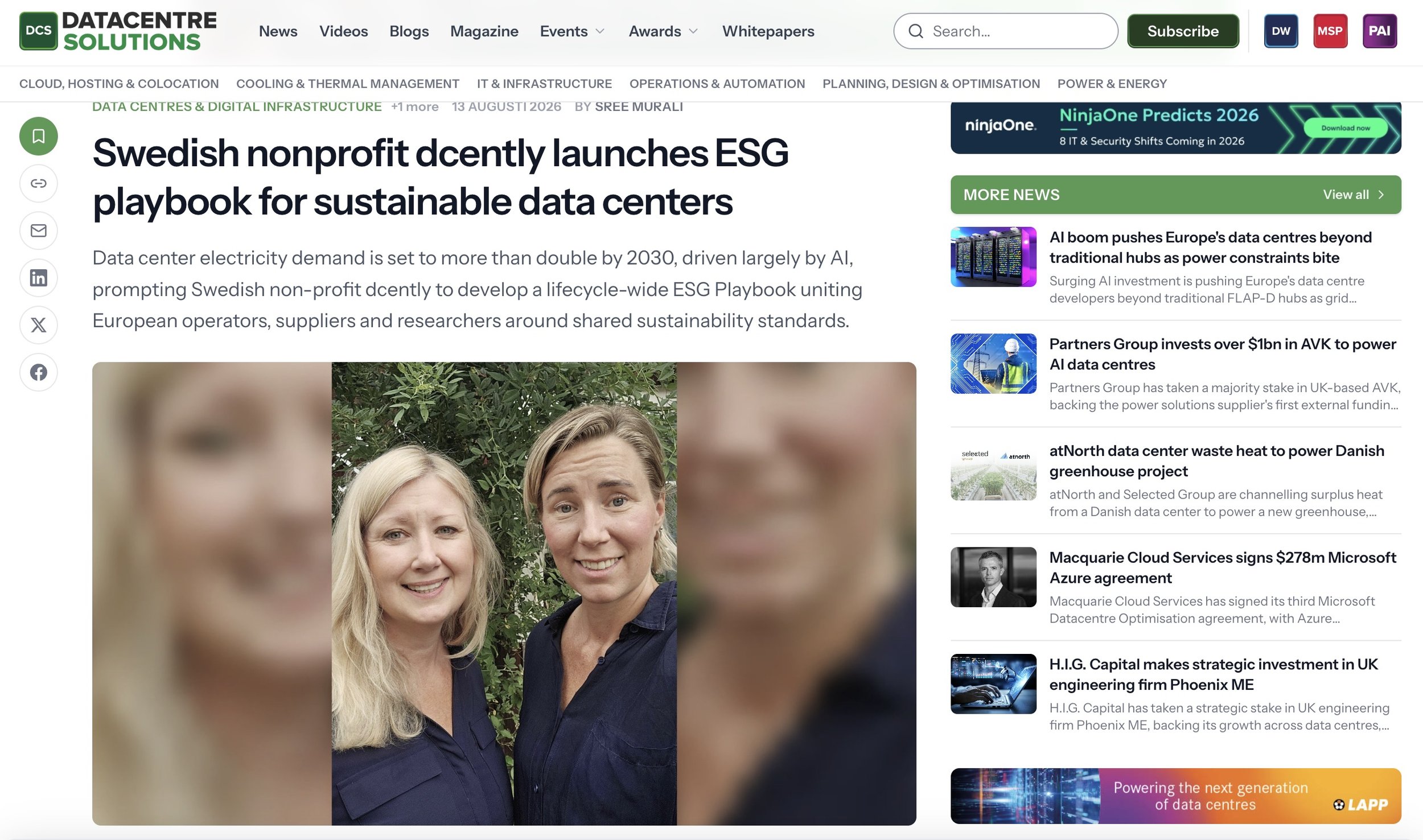
Data Centre Solutions has highlighted the launch of dcently and our ambition to bring the data center ecosystem together to develop a shared ESG Playbook. But behind the announcement sits a much bigger question: what should responsible digital infrastructure actually look like?
The data center industry is entering an extraordinary period of growth.
AI, cloud services and continued digitalisation are increasing demand for computing infrastructure at a pace few industries experience. At the same time, expectations around sustainability, transparency and the use of scarce resources are increasing.
This makes the question of how we build and operate data centers increasingly important.
But we believe there is an equally important question:
What are we actually trying to optimise for?
Sustainability cannot be reduced to a single KPI
For years, data center sustainability has understandably focused heavily on operational efficiency.
PUE has become part of the language of the industry. WUE is receiving greater attention. Renewable electricity, heat reuse and energy efficiency are increasingly important considerations.
All of these matter.
But none of them, individually, tells us whether a data center is sustainable across its entire lifecycle.
A highly energy-efficient facility may still have significant embodied impacts from construction and equipment. A cooling solution that reduces energy consumption may affect water use. Procurement decisions can move environmental and social impacts further upstream in the supply chain.
And a technically excellent data center can still struggle to gain local acceptance if its relationship with the surrounding community has not been considered.
Sustainability therefore cannot simply be a competition to achieve the best individual metric.
We need to understand the system.
Regulation is moving — and that is a good thing
Europe is already moving towards greater transparency.
Data center operators report sustainability information under the Energy Efficiency Directive, and the European Commission is developing a common EU sustainability rating scheme based on the data being collected.
This is important progress.
Comparable and auditable information can help operators, customers, investors and policymakers make better decisions.
But reporting operational performance and defining responsible digital infrastructure are not necessarily the same thing.
The next step is to connect operational performance with the broader environmental, social and governance impacts created throughout the lifecycle of a data center.
From the site to the supply chain
At dcently, we want to explore the data center as part of a much larger system.
That means looking at questions including:
where and how data centers should be located
how they are designed and constructed
energy, water and carbon
embodied environmental impacts
equipment and procurement
resilience and interaction with the energy system
supply-chain impacts
circularity and end-of-life
people and working conditions
communities and local value creation
governance, transparency and accountability
These questions are interconnected.
Water provides a good example.
Measuring water consumption at a data center site is important, but it is only part of the picture. Water impacts can also occur through electricity generation, construction and the manufacturing of semiconductors and other equipment.
At the same time, decisions about cooling can involve trade-offs between water, energy, carbon, resilience and cost.
Looking at only one part of that equation risks optimising one impact while increasing another.
No company controls the whole lifecycle
This is also why we believe collaboration across the industry is essential.
An operator cannot solve supply-chain impacts alone.
A supplier cannot determine how infrastructure is ultimately operated.
A sustainability professional does not necessarily understand every engineering constraint.
An engineer cannot independently address community acceptance, investor expectations or governance.
Customers influence demand. Investors influence capital allocation. Policymakers influence the conditions under which infrastructure can be developed.
No single actor controls the entire system.
If we want to understand what responsible infrastructure looks like, we therefore need the whole ecosystem in the room.
The dcently ESG Playbook
This thinking is the foundation for the dcently ESG Playbook.
Our ambition is not to create another certification or replace the many standards, frameworks and initiatives that already exist.
Instead, we want to connect them.
Together with operators, suppliers, customers, investors, researchers, engineers and sustainability professionals, we will identify the most material ESG questions facing the industry, explore trade-offs, share knowledge and translate what we learn into practical guidance.
The result should not be a static document.
It should become an evolving industry reference point — informed by evidence, grounded in operational reality and continuously developed as technology, regulation and expectations change.
Ultimately, we want to answer one deceptively simple question:
If we started with a blank sheet of paper today, knowing what we know about climate, water, resources, people and society — what would a decent data center actually look like?
That is the question behind dcently.
And we believe it is a question worth answering together.
dcently launches in autumn 2026. If you are part of the data center ecosystem and want to contribute to the ESG Playbook and help define The Decent Data Center, we would love to hear from you.